
Your full retirement age is arguably the most important number in Social Security, because so many things revolve around it. This includes how your claiming age affects your benefits, how much you can earn if you claim benefits before then, and how much your spouse is possibly eligible for.
For a long time, the full retirement age was 65, but after Congress passed the Social Security Amendments of 1983, this age increased for those born in 1938 or later. The full retirement age for people born in 1960 or later is 67. It was previously 66 years and 10 months for people born in 1959, many of whom have reached or will reach it during 2026.
Unfortunately, this isn’t music to many people’s ears.
Image source: Getty Images.
Who does this change hurt the most?
On paper, the full retirement age is just a number. In reality, it’s extra time someone must work before being entitled to their full monthly Social Security benefit (called your primary insurance amount).
If you’re a white-collar worker working in a cubicle, this extra time may be a matter of just pushing through to the finish line. If you’re a blue-collar worker who does physically taxing work (like construction or manufacturing), this extra time is adding more wear and tear to your body.
This higher full retirement age also negatively affects lower-income workers, because Social Security generally makes up a larger share of their income than it does for higher earners. What was once considered full retirement age is now considered early, and a reduction in benefits by claiming early can make a huge difference in what some retirees are able to purchase or do.
The same applies to someone whose health isn’t ideal. A higher full retirement age means having to trade off continuing to work with your health situation, or claiming Social Security earlier and dealing with the lower monthly benefit.
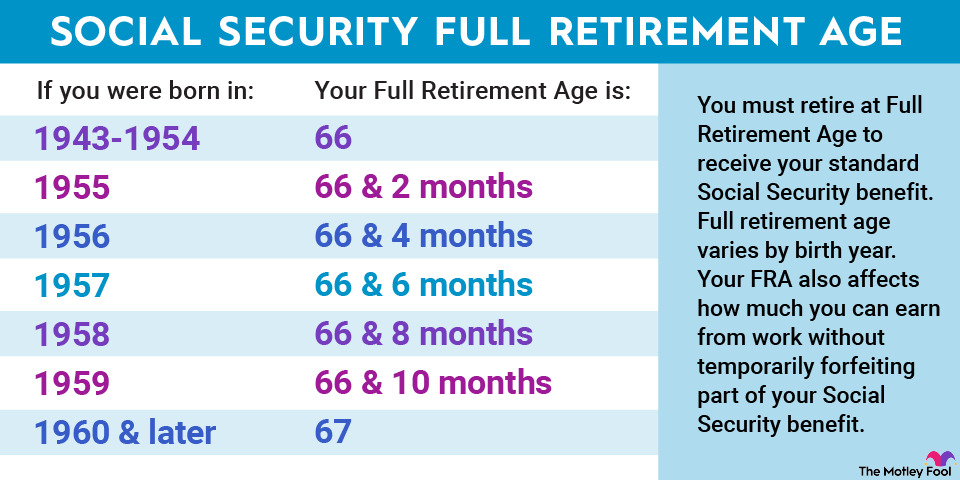
Image source: The Motley Fool.
How when you claim affects your Social Security benefit
The main reason to be aware of full retirement ages is how they affect your monthly benefit. Claiming benefits before or after your full retirement age will decrease or increase your monthly benefit, respectively.
Claiming benefits before your full retirement age reduces them by 5/9 of 1% monthly for the first 36 months. Each additional month you delay past that further decreases them by 5/12 of 1%. With a full retirement age of 67, here’s how much your monthly benefit will be reduced based on claiming age:
- Age 66: 6.67%
- Age 65: 13.33%
- Age 64: 20%
- Age 63: 25%
- Age 62: 30%
This means that if your benefit at full retirement age is $2,000, claiming at 64 would reduce it to $1,600, and claiming at 62 would reduce it to $1,400. Losing $400 or $600 monthly can make a big difference in someone’s retirement finances and flexibility.
Delaying benefits past your full retirement age increases them by 2/3 of 1% monthly, or 8% annually, until you turn age 70. Once you turn 70, benefits are no longer increased by delaying.