
Saving might sound like something that’s only reserved for financial experts and those with six figure salaries, but in reality, saving is more about habits and less about how much you earn. Even when your budget feels tight, there are still some small habits that can help you make room for savings. Small budget savings challenges are perfect for anyone who wants to build consistency and discipline when it comes to financial life. These challenges are fun and allow you to explore your creative side, making them a motivating way to save even if it is just a few dollars you can save a week. This article will help you explore 11 fun and exciting small budget savings challenges, helping you move towards a secure and stable financial future without having to deprive yourself completely.
1. The $1 Daily Challenge
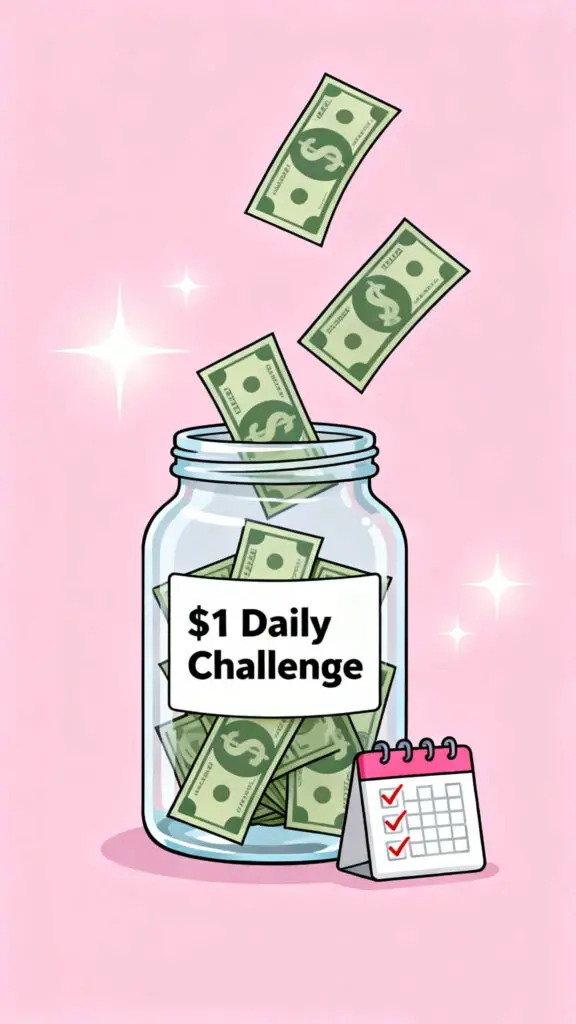
For something meaningful yet low effort, you can consider the $1 challenge that shows you how small but intentional efforts can serve you in the long run. This challenge is all about saving $1 every day for 365 days and at the end of the challenge you’ll have $365 saved without any extra effort.
The beauty of this challenge is that it’s simple and low maintenance, proving that saving doesn’t always have to be complex or complicated. You can use a glass jar, a small box, or even a digital savings account to track your progress, helping you become more motivated and consistent to continue with the challenge. Over time this habit can train your mind to prioritize consistency over big figures, a small mindset shift that can serve you in the years to come.
2. The 52-Week Challenge
Another considerable option is the 52 week challenge which is all about starting small and gradually increasing the amount as you move on with the challenge. In the 52 week challenge, you save $1 in week 1, $2 in week 2, $3 in week 3, and so on to $52 in week 52. By the end of the year when you finish the challenge, you’ll have $1378 saved in a low effort yet highly effective way.
You can also reverse the challenge if you feel like starting big and gradually moving to the easier and doable part of the challenge. The reverse 52 week challenge involves saving $52 in week 1, $51 in week 2, $50 in week 3, and so on to $1 in week 52.
3. The Spare Change Challenge

If you often find spare changes or small coins lying around the house, that’s your cue to start the spare change challenge. This challenge is all about saving spare change either in a jar or in a box. This challenge may sound simple and small but over a few months you’ll realize how quickly those small changes add up.
It’s a stress free challenge as it doesn’t require you to follow strict rules or save a fixed amount, it is a flexible challenge that just involves collecting and saving any spare change. What makes this challenge a considerable option is that at the end, you can see how sometimes the most effortless of habits can result in meaningful rewards, serving as a reminder that consistency and intention matter far more than big amounts.
4. The No-Spend Weekend Challenge
For a challenge that helps you hold back on non-essential spendings, consider the no-spend weekend challenge which involves picking one weekend a month where you commit to spend nothing on those wants or nice-to-have items.
Instead of spending money, you can look for low cost and pocket-friendly alternatives that are just as much fun whether it’s cooking at home, going for a walk, or spending time with your loved ones doing free activities.
Not only does this challenge help you save instantly, it also helps you realize that those seemingly necessary expenses only bring temporary satisfaction, urging you to rethink your spending choices and making necessary modifications to it.
5. The 5-Dollar Bill Challenge
The 5 dollar bill challenge is a simple and straightforward challenge which is all about putting aside your $5 bill, whenever you get one, no questions asked. Since $5 feels small enough not to make a big difference in your day-to-day spending, it becomes an easy habit to stick with.
Over time, you’ll start noticing that your savings are growing faster than you expected. This challenge works especially well if you handle cash regularly, and it gives you that satisfying feeling of saving without any pressure or complicated planning.
6. The Pantry Challenge
For a creative and practical challenge that puts your problem-solving and decision-making skills to work, go for the pantry challenge. The pantry challenge is all about cooking meals using only the ingredients available in your pantry.
Not only does this challenge help you save money by reducing takeout, dining out, or getting food delivered, it reduces grocery costs, reduce food waste, helps you explore your kitchen skills, and most importantly allows you to eat nutritious and hygienic food made at home.
Whether it’s a fun new kitchen experiment, mixing up leftovers, or using items you’ve forgotten about, the pantry challenge can be the perfect option for anyone who wants to save money while learning to make the most out of what they already have.
7. The 30-Day Round-Up Challenge
For a simple challenge, consider the 30-day round-up challenge which is all about rounding up your purchase to the nearest dollar, $5, or $10, and saving the difference. For example, if you spent $7 on coffee, set aside $3 and save them. Similarly, if you spent $7.40, you can round it up to $8 and save 60 cents.
While these small amounts may not seem much to help your savings grow, over time, they can add up and you won’t even feel the difference in your daily spending. What makes this challenge a considerable option is that by the end of it, you can see a surprisingly good figure saved without putting in extra effort, simply by building a habit that’s simple but highly beneficial.
8. The Envelope Challenge
The envelope challenge is one of the most practical and eye-opening ways to get hands-on with your savings. It’s all about dividing your money into physical envelopes that represent different spending categories, such as groceries, transportation, eating out, or entertainment. You can set a spending limit for each category at the start of the month and place that specific amount of cash inside its envelope. The key is simple, once the money in an envelope runs out, you can’t spend any more in that category until the next month begins. This challenge helps you stay aware of your spending habits, prevents overspending, and teaches you how to make thoughtful financial choices.
9. The Subscription-Free Month
In today’s world, it’s so easy to forget how many subscriptions quietly take small portions of your income every month, from streaming services to apps, magazines, and even fitness memberships. The subscription-free month challenge encourages you to cancel or pause all non-essential subscriptions for 30 days and live without them.
At first, it may feel a bit unusual, but it can be surprisingly refreshing to realize how many of those subscriptions you barely use or even miss. At the end of the challenge, you might find that some of those paid subscriptions weren’t adding real value to your life at all, and keeping them canceled could help you save even more in the future.
10. The 100 Envelope Challenge (Mini Version)
If you’re looking for something slightly more structured but still manageable, the 100 envelope challenge (mini version) is a great pick. The traditional version involves labeling 100 envelopes with numbers 1 through 100 and saving the amount written on the envelope you pick each day, but the mini version simplifies it for smaller budgets.
You can use 50 envelopes or even 30, depending on your comfort level. Each time you pick an envelope, you save the number written on it, and by the end of the challenge, those small amounts will turn into a surprisingly large sum.
11. The “Save Your Bonuses” Challenge
The “save your bonuses” challenge is a simple yet powerful habit that focuses on putting away any extra money you earn rather than spending it right away. Whether it’s a work bonus, a cash gift, tax refund, or even a small reward from selling something you no longer need, this challenge encourages you to save it all. The best part about this challenge is that it doesn’t affect your day-to-day budget since the money isn’t part of your regular income, making it easier to save without feeling deprived.
Conclusion
Saving money doesn’t always require drastic lifestyle changes or large sums to begin with, sometimes it’s the small, consistent habits that create the biggest difference over time. These 11 small-budget savings challenges are designed to fit easily into everyday life, helping you build discipline, creativity, and mindfulness around your spending. Whether you’re collecting spare change, cooking from your pantry, or pausing your subscriptions, each challenge adds a little strength to your financial mindset. The key is to focus on progress, not perfection because every dollar saved is a step closer to financial freedom. With patience and consistency, these small efforts can turn into meaningful long-term results, giving you more control and peace of mind over your financial future.