
ONEOK (NYSE: OKE) has agreed to buy Brazos Midstream’s Permian Midland Basin gathering and processing assets, the company said on 30 August 2026. The Tulsa-based pipeline operator will pay $4.425bn in cash for the network, according to a statement filed with PR Newswire.
The figure held up across the wires. Reuters put the price at approximately $4.43bn, while Seeking Alpha rounded it to $4.42bn – rounding variance, not a discrepancy.
What the ONEOK Brazos Midstream deal actually buys
The assets are natural gas gathering and processing infrastructure in the Permian’s Midland sub-basin, one of the busiest US shale plays for associated-gas volumes. ONEOK says the acquisition pushes it toward the high end of its mid- to high-single-digit adjusted EBITDA growth target over the next five to seven years, and expects the deal to be immediately accretive to earnings and free cash flow per share.
Those forward-looking claims come from the company’s own release. They are not, on their own, unusual for an acquiring company to say on announcement day – but they sit alongside far bigger numbers that deserve more scrutiny.
The $9bn Apollo figure nobody outside ONEOK has confirmed
ONEOK’s statement describes a $9bn minority equity investment from Apollo-managed funds tied to the transaction, plus $5bn of debt extinguishment, which it says would accelerate deleveraging to 3.25x debt-to-EBITDA without any issuance of common equity. Those figures dwarf the $4.425bn asset price itself.
No 8-K or transaction-specific filing disclosing the Apollo financing appears yet in ONEOK’s EDGAR filing history, which currently runs only through routine 10-Q reporting for the second quarter of 2026. Every outlet that has covered the deal – Reuters, Seeking Alpha, GuruFocus, Yahoo Finance – has repeated the company’s own wording on the financing structure rather than sourcing it independently. Until a primary filing or a statement from Apollo itself lands, the $9bn and $5bn figures should be read as company-sourced claims, not independently verified facts.
A familiar pattern of scale
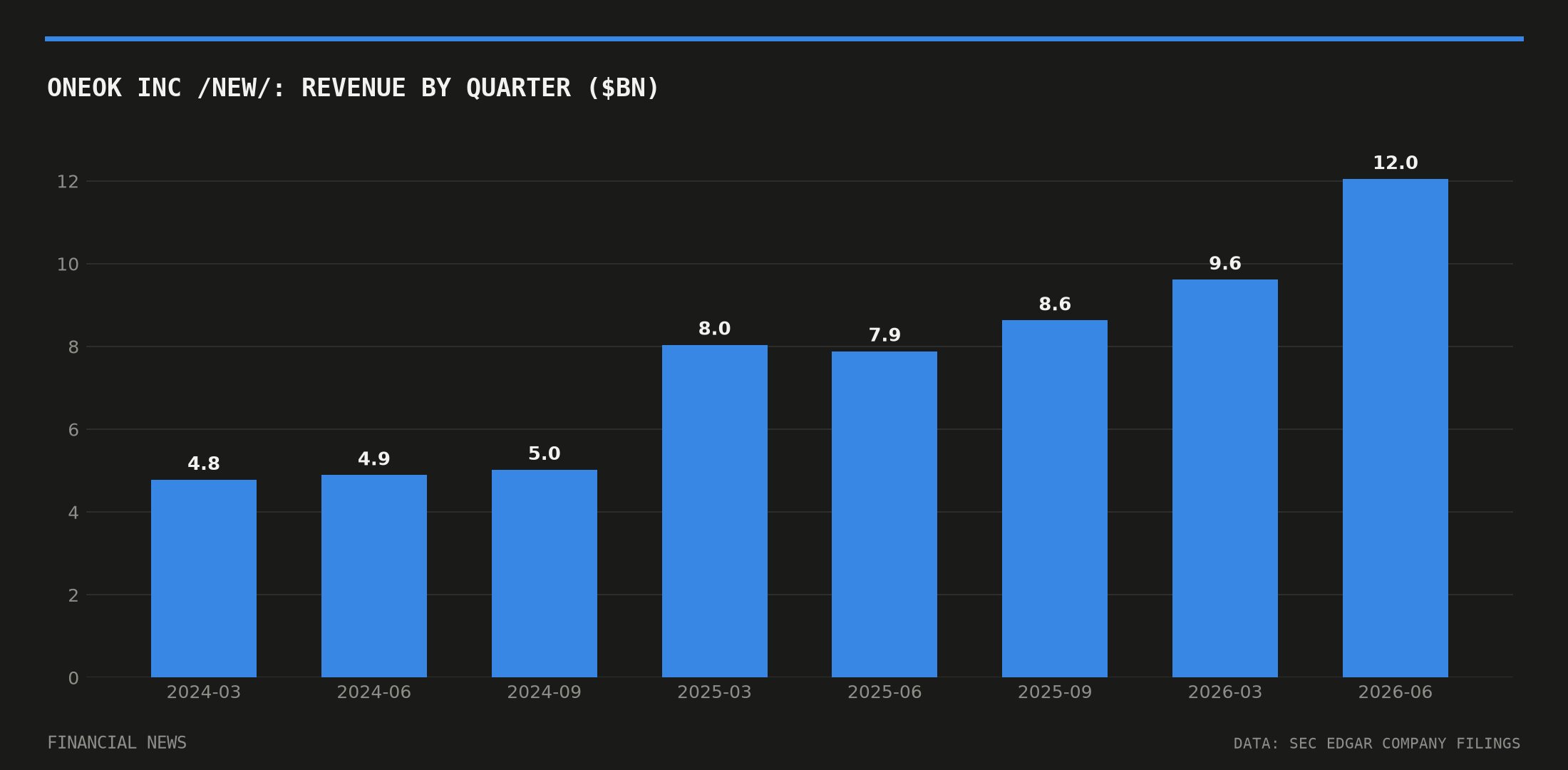
The Brazos purchase extends a run of large bolt-on acquisitions that has reshaped ONEOK’s balance sheet over the past two years. Quarterly revenue climbed from $4.781bn in the first quarter of 2024 to $12.049bn in the second quarter of 2026, according to filings with the SEC. Net income over the same stretch rose from $639m to $966m per quarter.
That trajectory reflects ONEOK’s broader strategy of stitching together midstream assets across US shale basins rather than organic growth alone – a pattern investors will likely map the Brazos deal onto once more detail on financing emerges.
Market reaction so far
OKE shares closed at $95.55 as of 31 August 2026, up 0.53% on the day and 10.72% over the prior 20 trading sessions, touching a 20-day high of $97.95. Trading volume ran roughly in line with the 20-day average, at 96% of the norm.
FINRA’s daily short-sale volume ratio for the stock ranged between 0.455 and 0.815 across the ten sessions to 28 August, showing no spike in bearish positioning around the announcement window, according to FINRA data.
The backdrop for financing a deal of this size has shifted modestly too. The 10-year Treasury yield stood at 4.67% on 27 August, against 4.66% previously, while the 10-year/2-year spread narrowed to 0.39 percentage points from 0.47, according to Federal Reserve data – a flattening curve that midstream dealmakers watch closely when weighing debt-heavy structures against equity alternatives.
Investors will be watching for the transaction-specific filing that would confirm the Apollo financing terms, and for any statement from Apollo itself on the size and structure of its stake. Until then, the $4.425bn asset price is the only number in ONEOK’s announcement that market participants can check against an independent source.
This article is for information only and is not investment advice or a recommendation to buy or sell any asset. Markets move quickly; figures are correct as sourced at the time of writing. Always do your own research before making financial decisions.